Concert Promotion Ideas for Bars and Music Venues
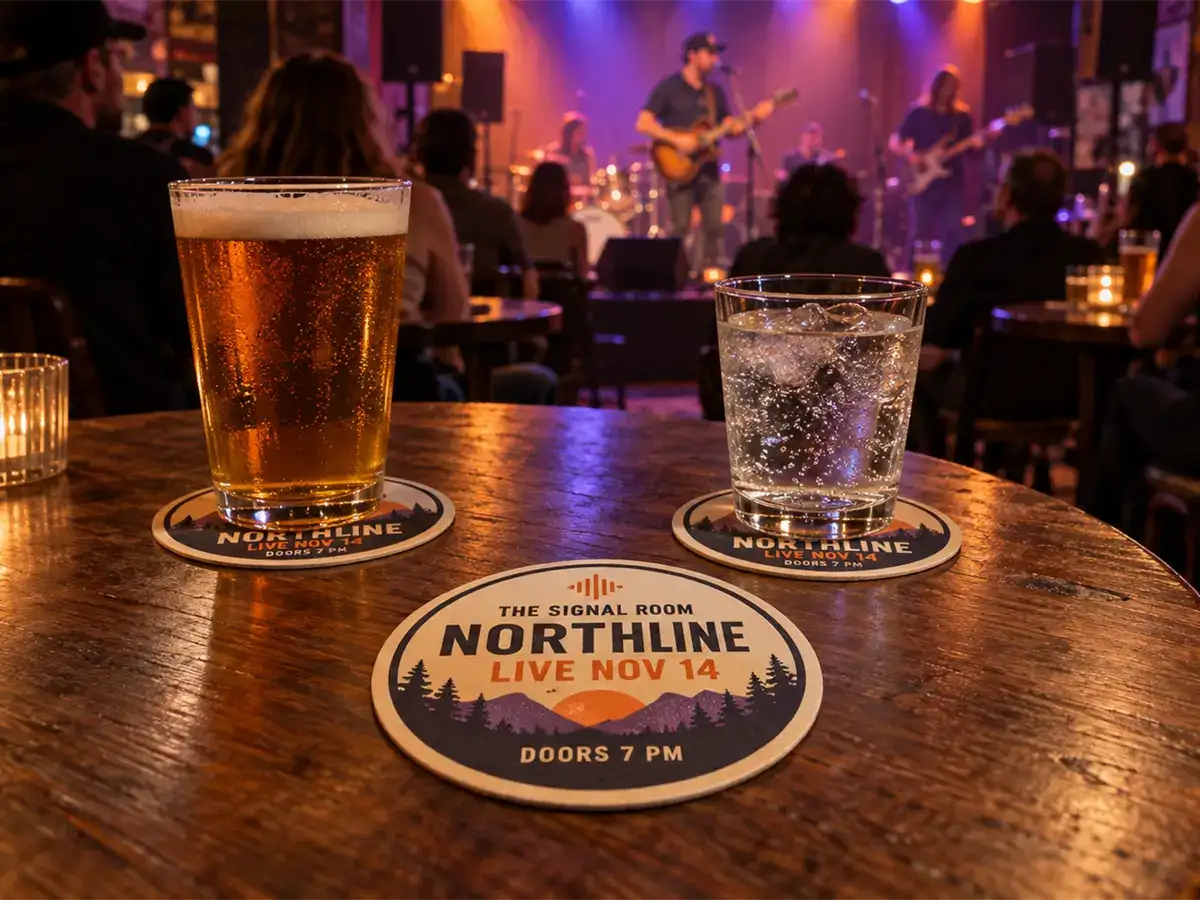
 A great show brings guests in. A well-designed coaster invites them back for the next one. - Coaster Factory
It is Friday night at a bar with a small stage. The room is full of regulars, a local band is loading in, and your next ticketed show is four weeks away. The most practical concert promotion ideas start right here, with the people already in your room. They like your venue, they came out on a show night, and they are the easiest audience to tell about the next one.
The challenge is visibility. A poster by the door gets walked past. A social post reaches whoever the platform decides to show it to. Printed materials get ordered late or designed with details too small to read in a dim room. This guide covers how to put upcoming shows in front of guests where they actually sit. It also covers how to support that with your own channels and how to time printed pieces so they arrive before the promotion window opens.
What you'll learn:
- Compare in-venue promotion options and see where coasters fit
- Use custom coasters to carry show dates, ticket links, and sponsor branding
- Plan quantities and timelines around proof approval, production, and shipping
Summary:
- Start with your in-house audience: guests already at your bar, your opted-in email and text lists, and your staff.
- Use several in-venue materials together, and use coasters for the job they do best: keeping the next show on the table for the whole visit.
- Match the order to your quantity and promotion schedule. Choose Short Run for smaller campaigns or Value Pack for ongoing use, and plan delivery before your first in-venue promotion date.
Why Concert Promotion Ideas Should Start Inside Your Venue
Paid advertising and social media reach people who may never have visited your venue. Guests at your bar have already chosen to be there. We recommend promoting to them first, then using outside channels to extend that reach.
This approach also keeps promotion within your control. You decide what goes on your tables, walls, and menus. You own your email and text lists. You can brief your staff before every shift. None of that depends on an algorithm or an ad auction.
In-venue promotion works best when it is consistent. Putting the next month's lineup on tables gives guests more opportunities to notice upcoming shows. Keep the layout recognizable so regulars can quickly find new dates during each visit.
Your in-house audience includes:
- Guests at the bar and tables on any given night
- Past ticket buyers who opted in to your email list
- Subscribers who opted in to text alerts
- Staff who can mention upcoming shows during service
In-Venue Promotion: Comparing Your Options
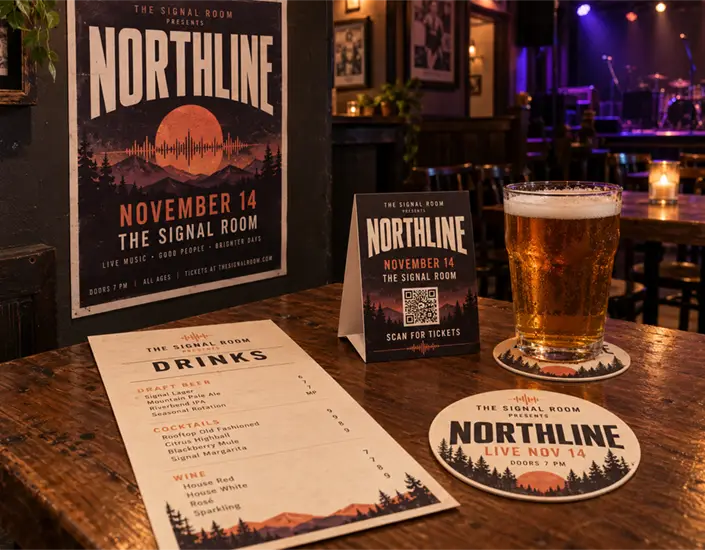
Most venues use a mix of printed materials, and each one has a role. Coaster Factory makes coasters only. Posters, table tents, and printed menus are worth having too, and a local print shop is a good partner for those pieces. The comparison below shows where each option tends to work and where coasters add something the others do not.
| Option | Where it lives | What it does well | Limitations |
|---|---|---|---|
| Posters | Entry, restrooms, bar back | Large visuals, visible from a distance | Easy to walk past; one location |
| Table tents | Tabletops | Eye level at the table | Can get moved aside or knocked over |
| Printed drink menus | Tables and bar | Handled by guests when they order | Reprinting menus for each show is impractical |
| Custom coasters | Under every drink | In use the entire visit; guests can take one home | Small print area limits how much fits |
A coaster puts show information beside a guest's drink, creating opportunities to notice the design as the glass is lifted. Pulpboard also absorbs condensation and helps protect the table. Include coasters alongside posters, table tents, and digital promotion to bring upcoming shows into the spaces guests use.
Coaster Ideas That Promote Upcoming Shows
The ideas below turn promotional coasters into working show promotion. Each one gives the coaster a single, clear job.
Show-Calendar Coasters
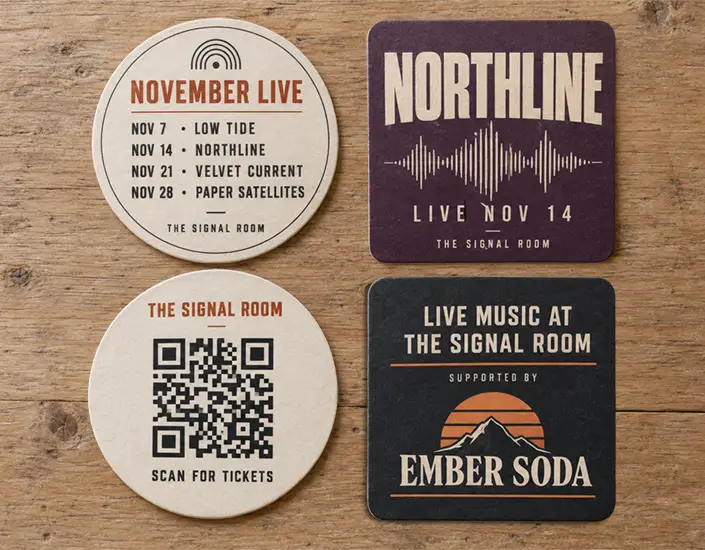
Print the next four to six weeks of shows on one design: date, artist, and start time. Rotate the design monthly to keep the calendar current. A single calendar coaster can promote several shows at once, which makes it an efficient use of each print run.
Keep the listing short. Four or five shows with clear dates will be easier to read than a crowded month of small type.
QR Codes That Link to Tickets
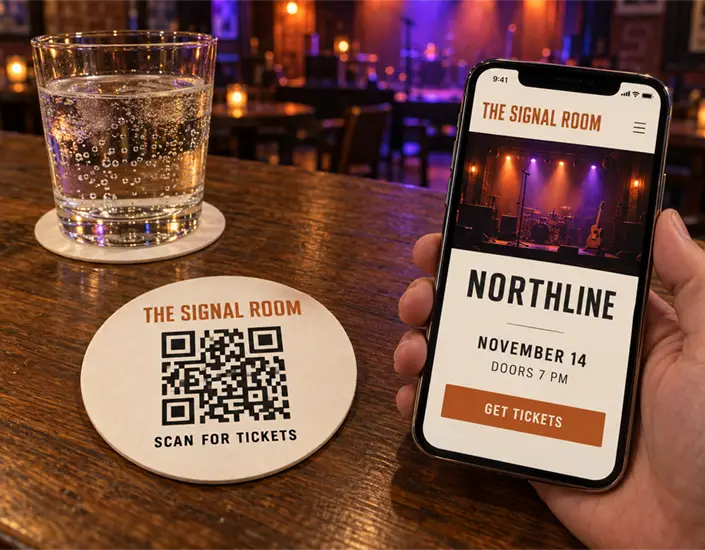
A QR code lets guests open your ticket page from the table. For a single headline concert, link directly to that event's ticket page. For a monthly calendar or recurring live music program, link to an upcoming-shows page that stays useful as dates change.
Add a clear instruction such as "Scan for Tickets". Keep the code high-contrast with clear space around it, and test the final artwork at its intended printed size, including under the venue's lighting.
For campaign tracking, a shared QR code can direct guests to a dedicated ticket or landing-page link. If each coaster needs an individual identifier for a contest or redemption offer, ask about variable printing coasters.
Artist Spotlights and Residencies
For a headline show, dedicate a coaster to the artist with the name, date, and a short line about the performance. Use artwork cleared by the artist or their team. For a monthly residency, one design can carry every date in the series, so guests see the full run at once.
Sponsor and Partner Co-Branding
Beverage brands, local businesses, and event sponsors often look for visibility at shows. A co-branded coaster with the sponsor's logo on one side and your show information on the other gives the sponsor a presence at every table. Confirm that the sponsor has approved use of their logo, and build their review into the proof timeline. If their logo depends on a specific brand color, discuss it before proof approval, since CMYK may not reproduce every brand color exactly.
Commemorative and Series Designs
Anniversary shows, holiday concerts, and annual events can carry a dated design that guests may choose to keep. Some venues release a small series across a season. For shaped designs, such as a guitar-pick outline, ask about custom shapes within 4"x4" before you finalize artwork.
How Guests Interact With Coasters on Show Nights
Knowing how coasters get handled on a show night helps you decide what belongs on them.
Before the set, guests are waiting. They are at the table with a drink, often looking around the room or at their phones. A coaster with the next show's date is one of the few printed items within arm's reach during that stretch.
During the set, the coaster stays under the glass. Attention is on the stage, so this is not the moment for fine print. Clear dates and a recognizable design matter more than detail.
After the show, some coasters leave with guests. A coaster with a date and a QR code does more work on a kitchen counter than one with only a logo.
Bars that host music most nights can use the same approach with everyday bar coasters, keeping a standing "Live music every Thursday" message on the table between ticketed events.
Support Your Promotion With Email, Text, and Social
Coasters and other in-venue materials reach guests already in the room. Email and text reach subscribers between visits, while social posts and artist shares can extend the campaign. Use consistent show details, artwork, and ticket destinations across these channels.
- Send to your own opted-in list, and collect sign-ups at the door, at the bar, or through a QR code
- Feature one show per email with a clear date and ticket link
- Segment by genre if your ticketing system records past purchases
- Plan a short sequence per show: announcement, reminder, and a final notice close to the date
Text Alerts
- Collect clear opt-in consent before adding anyone to a text list, and include a way to opt out
- Save texts for time-sensitive messages such as presale access or day-of details
- Keep each message short with a single link
- Limit texts per show so subscribers do not tune them out
Social Media
- Post short video clips from soundcheck, stage setup, or past shows
- Ask artists to share the show with their own followers
- Reshare guest posts from past shows, with permission
- Expect reach to vary from post to post, and treat social as support for your other channels rather than a replacement
Measure Your Concert Promotion
Use a dedicated ticket or landing-page link for your coaster campaign. Track visits through that link and, where your ticketing platform supports it, completed purchases. If the coaster promotes email sign-ups, track completed registrations.
A QR scan shows interest but does not establish a ticket sale. Review the results after each campaign and use them to adjust the next design, ticket destination, or distribution plan.
Local Partnerships and Cross-Promotion
Partnerships extend your reach without requiring you to build a new audience from scratch.
- Offer ticket-and-dinner packages with nearby restaurants
- Ask nearby hotels to mention shows to guests
- Trade tickets with local radio stations for community calendar mentions
- Co-promote with breweries or beverage partners who pour at your venue
- Build social posts into artist booking agreements
When you partner with another business, each partner should promote to its own audience. Swapping email or text lists without subscribers' consent can break trust with those subscribers and may conflict with the terms they signed up under. A shared coaster design is a simpler way to cross-promote: each partner distributes the same co-branded event coasters at their own location, and both audiences see the show.
How to Design Show Coasters That Print Cleanly
Concert venues are dark, and coasters are read at arm's length. Design with the room in mind.
Content Checklist
- Limit each coaster to one job: a show calendar, a single headline show, a ticket link, or a sponsor message
- Put dates and start times where guests can find them first
- Use high contrast between text and background for dim lighting
- Keep body text large, and avoid thin fonts that disappear in low light
- Leave clear space around QR codes
File Preparation Checklist
- Follow the artwork requirements for your selected product. For Value Pack and High Volume orders, use CMYK artwork and the bleed, safe area, and resolution requirements in our File Specifications. Short Run orders have separate artwork guidance.
- Confirm usage rights for artist photos, logos, and sponsor marks
- Check every date, time, and artist name before you submit
- Review the proof carefully for wording, layout, placement, and orientation
For a distinctive night-show design, ask about glow-in-the-dark coasters and whether the effect suits your venue's lighting.
Ordering Guidance: Building Coasters Into Your Promotion Timeline
Work backward from the date you want coasters on tables. Allow time for artwork preparation, proof approval, production, and shipping. Production begins after artwork approval, and shipping time is additional. The table below lists the typical production times for Short Run and Value Pack orders.
Color: Our standard full-color coasters use CMYK process printing. Some bright or specific brand colors may reproduce differently in CMYK. If an artist's logo or sponsor's brand color requires a close match, discuss the available options with us before approving the artwork.
Artwork approval: If you order through Coaster Designer, review the on-screen artwork before confirming your order. For Value Pack and High Volume orders handled directly by our team, review and approve the emailed PDF proof before production. Check wording, dates, layout, placement, and orientation carefully. A digital proof is not a physical printed sample and does not show the board's texture or guarantee final printed color.
Specialty options: For variable printing, glow-in-the-dark printing, or custom shapes, confirm available quantities, pricing, artwork requirements, and production time before planning your campaign. The standard Short Run and Value Pack turnaround estimates should not be assumed to apply to these options.
Short Run or Value Pack
Short Run and Value Pack are separate product lines with different quantity ranges and production times.
| Short Run | Value Pack | |
|---|---|---|
| Quantity range | 25 to 500 coasters | 1,200 to 25,000 coasters |
| Production time | 3 to 5 business days after proof approval | 10 to 15 business days after proof approval |
| Shipping | Separate, added after production | Separate, added after production |
| Typical fit (our recommendation) | Single headline shows, one-night events | Monthly calendars, residencies, sponsor programs |
Short Run coasters suit a single show or a small room. Value pack coasters suit designs that run all month or across a series. If your estimate lands between the two ranges, ask about the right option before you finalize artwork.
Estimating Quantities
The examples below assume two coasters per guest per visit. Adjust that assumption to match your venue's service and replacement practices.
- Single headline show: 250 expected guests x 2 coasters = 500 coasters.
- Monthly residency: 4 shows x 150 expected guests per show x 2 coasters = 1,200 coasters.
- Monthly show calendar: 26 open nights x 80 expected guests per night x 2 coasters = 4,160 coasters.
Allow extra for damaged coasters and any planned take-home distribution. These calculations are planning estimates; confirm available order quantities before ordering. If you want several designs within one order, ask about that when requesting your quote.
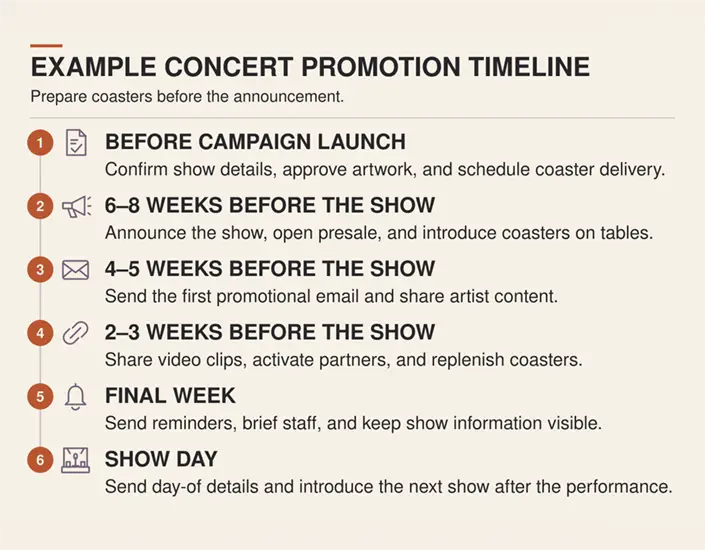
Example Concert Promotion Timeline
This example assumes coasters will be on tables when the show is announced six to eight weeks before the concert. Complete the ordering steps before that launch date, using the confirmed production and shipping schedule for your order.
| When | Promotion | Coaster tasks |
|---|---|---|
| Before campaign launch | Confirm the artist, show details, ticket page, and promotional artwork | Submit artwork, complete approval, and schedule delivery before the announcement |
| 6 to 8 weeks before the show | Announce the show and open presale to your lists | Introduce the show coasters on tables and at the bar |
| 4 to 5 weeks before the show | Send the first promotional email and share artist content | Keep coasters stocked throughout the venue |
| 2 to 3 weeks before the show | Share video clips and activate partner promotion | Replenish coasters and check that ticket links remain current |
| Final week | Send reminders and brief staff | Keep show information visible during service |
| Show day | Send day-of details | Introduce the next show or upcoming calendar after the performance |
Shipping time varies by destination, so leave a few days of buffer after the expected arrival. Don't plan around rush production unless it's confirmed for your order.
Frequently Asked Questions
What should a venue print on concert promotion coasters?
Give each coaster one job. A show-calendar coaster lists the next four to six weeks of dates, artists, and start times. A headline-show coaster focuses on one artist and date. A sponsor coaster pairs the sponsor's logo with your show information. Add a QR code that links to your ticket page, and keep text large and high-contrast for dim rooms.
Can a coaster link guests directly to ticket sales?
Yes. A printed QR code can link to your ticket page. Point it to a page that lists all upcoming shows so the code stays useful after one show passes. Check the code's size and placement on the proof, and leave clear space around it. For a unique code on each coaster, ask about variable printing coasters.
How many coasters does a venue need for a concert promotion?
Estimate expected attendance across the nights the design will be used, then account for your venue's coaster replacement practices. Use the worked examples in Estimating Quantities above as a starting point, and confirm the available order quantity before ordering.
How far ahead should a venue order show coasters?
Start with the date you want coasters on tables. Use the production estimates in Ordering Guidance above, add the shipping estimate for your destination, and allow time for artwork preparation and approval. Confirm the expected arrival date before scheduling your promotion.
Next Steps for Your Show Calendar
Give guests a clear way to book their next visit. Put upcoming show dates and a ticket link on your coasters, then reinforce the message through staff, email, text, and social posts.
Send us your artwork, expected quantity, shipping destination, show date, and the date you want coasters on tables. Our team can help confirm the printing options and delivery plan for your campaign. Request a quote.
Share: