How to Plan Sports Bar Game Day Promotions for the Whole Year
 The game brings fans in. Let your coaster invite them back. - Coaster Factory
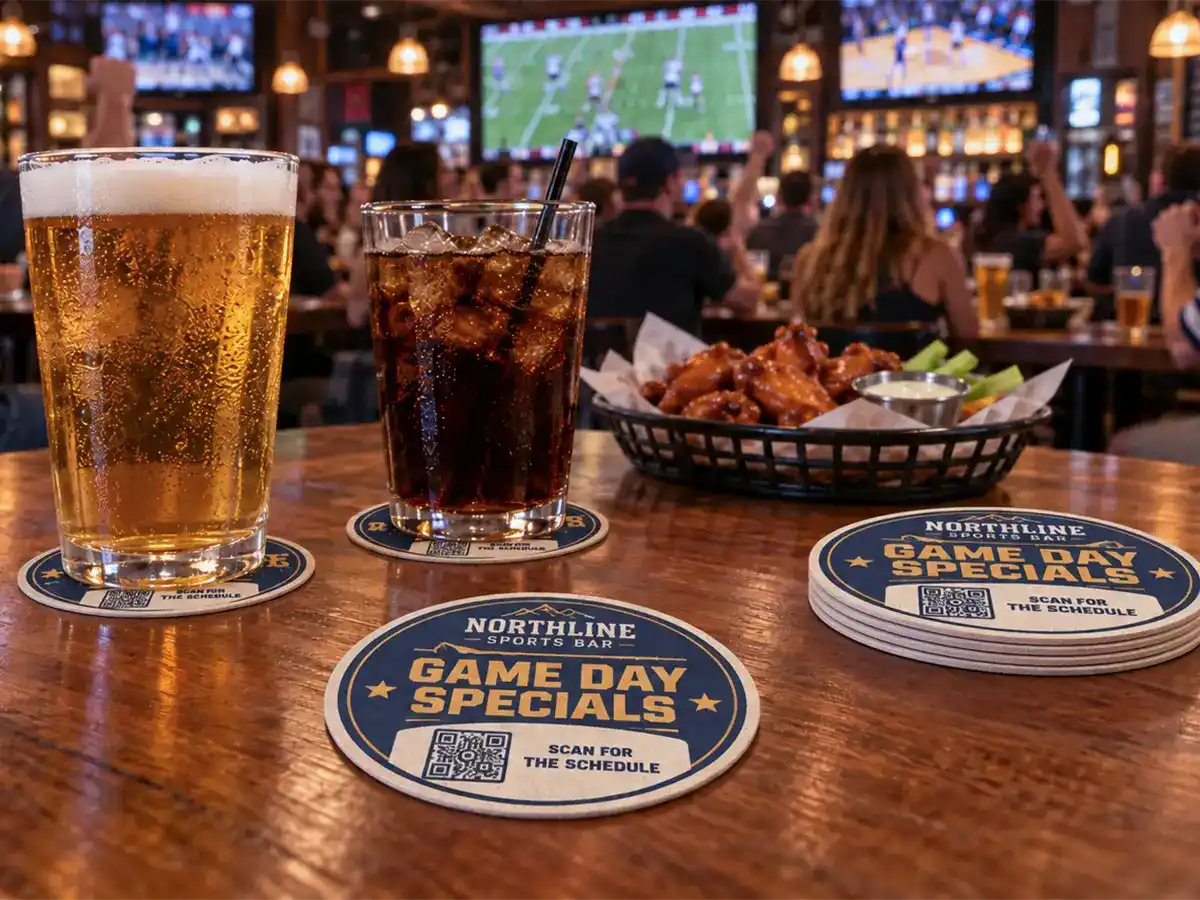
It is Sunday afternoon in a sports bar. Every screen has a game on, the kitchen is running wings and nachos, and a custom coaster sits under nearly every glass. The most dependable sports bar game-day promotions are built for this kind of afternoon, repeated year-round rather than saved for one championship weekend.
The challenge is giving guests a reason to visit between the biggest games. Build your calendar around the sports your regulars follow, then use recurring viewing nights and promotions to fill quieter periods. This guide explains how to plan that calendar, promote it at the table, and order coasters before each season or event.
What you'll learn:
- Build a sports calendar that fills the months between major events
- Use custom coasters to promote specials, games, and league nights at every table
- Plan quantities and timelines around proof approval, production, and shipping
Summary
- Plan game day promotions across the full year, including soccer, women's leagues, college sports, and local teams, not just football season.
- Put the calendar on the table with coasters that carry specials, upcoming games, and league nights, and keep trademarked names off anything you print without permission.
- Choose Short Run for individual events and Value Pack for season-long programs. Allow time for artwork, proof approval, production, and shipping.
Why Sports Bar Game Day Promotions Need a Year-Round Plan
A single championship weekend can fill a room once. A full calendar of games gives guests a reason to come back every week. We recommend treating game day promotion as an ongoing program, with a steady rhythm of events and specials that regulars can learn.
A recurring promotion helps servers learn the specials, lets the kitchen plan for volume, and makes setup routine, leaving staff more time to focus on service.
It helps your regulars, too. "Soccer mornings on Saturday" or "league night every Tuesday" is easy to remember and easy to pass along to friends. A calendar that changes without a pattern makes guests check your social feeds just to know what is on.
Finally, a steady calendar simplifies your printed materials. A season-long coaster design stays accurate for months, while seasonal designs can be planned well ahead of each league's start date.
Building a Year-Round Sports Calendar
The goal is a calendar with something worth watching in most weeks of the year. Start with the leagues your regulars already follow, then add programming that fills the gaps.
Football Season
If football is a major draw for your regulars, plan specials, seating, and staffing around the full season. Choose recurring viewing dates that fit the fixtures and your customers' habits.
College Basketball Tournament Season
The spring college basketball tournaments bring games across weekday afternoons and evenings, which are often slower hours for sports bars. Bracket contests, office group bookings, and viewing parties for regional teams can fill those hours. Use generic language, such as "tournament season" or "bracket party," in anything you print.
Soccer, Women's Leagues, and Other Sports
Soccer and Women's Sports
Build dedicated viewing nights around the soccer clubs and women's leagues your guests follow. Confirm game times before promoting early-morning, midday, or evening events.
Hockey, Baseball, and Other Sports
Hockey, baseball, and combat sports can give your calendar additional viewing opportunities. Ask regulars which teams and events they want to watch, then test a recurring night before committing to a season-long promotion.
Local Teams and Community Games
Regional college teams, minor league affiliates, and high school championships give your bar a community role. Local games can draw families, alumni, and players' friends who might not visit for a national broadcast. A co-branded coaster for a local team's season, with the school or club's approval, supports the relationship.
Off-Season Programming
During quieter periods for your main sports audience, plan draft-night gatherings, sports trivia, or other viewing events. Choose activities that fit your staffing, budget, and available viewing rights.
Sample Year-Round Promotion Plan
Use this example to organize the year, then select events from your confirmed sports schedule and the interests of your regulars.
| Planning period | Event focus | Promotion | Example coaster message |
|---|---|---|---|
| January-March | Weekly viewing nights and tournament events | Group table reservations | Bring Your Team. Reserve Your Table. |
| April-June | Local-team games and midweek viewing | Recurring food special | Your Weekly Game Night Starts Here. |
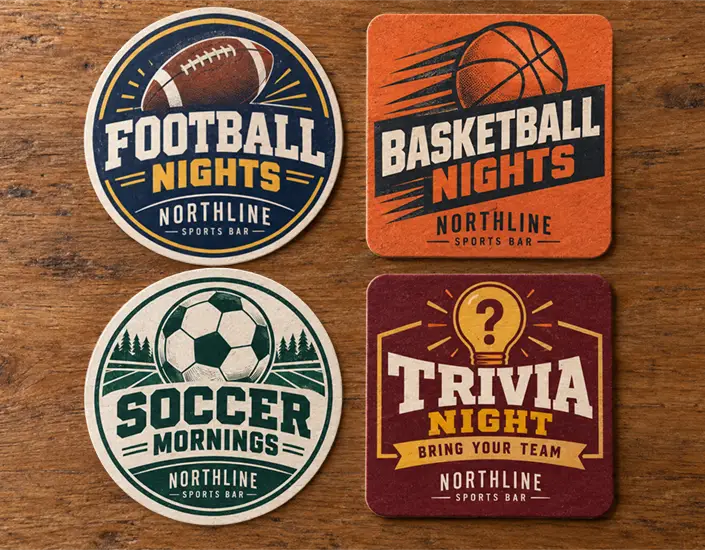
| July-September | Viewing nights and sports trivia | Trivia team registration | Scan for This Week's Games and Trivia. |
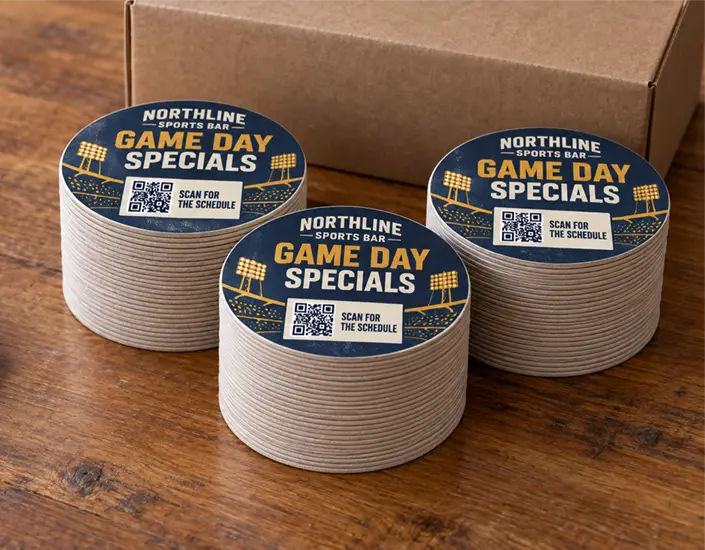
| October-December | Season openers, rivalry games, and league nights | Standing game day specials | Game Day Specials. Scan for the Schedule. |
For each promotion, record the event date, desired coaster arrival date, and artwork deadline. Use Ordering Guidance below to work backward through design, proof approval, production, and shipping.
Calendar Planning Checklist
- Map the next 90 days of games and events, then extend the plan to a full year
- Confirm commercial viewing rights for live broadcasts and any replays or documentary screenings you plan to show
- Reserve dates for bracket parties, draft nights, and season openers well ahead of time
- Identify local teams and schools for community tie-ins
- Schedule coaster artwork and proof approval for each season (see Ordering Guidance below)
Game Day Promotion Ideas With a Coaster Tie-In
The ideas below pair a game day promotion with a coaster that does real work at the table.
Food Specials and Non-Alcoholic Options
Rotate game day food specials with options such as wings, sliders, loaded nachos, or shareable platters. Include non-alcoholic drinks and mocktails in your specials so every guest has something to order.
If you run drink specials, check your local liquor regulations first. Some jurisdictions restrict certain types of drink promotions, and specials tied to scoring can encourage fast drinking.
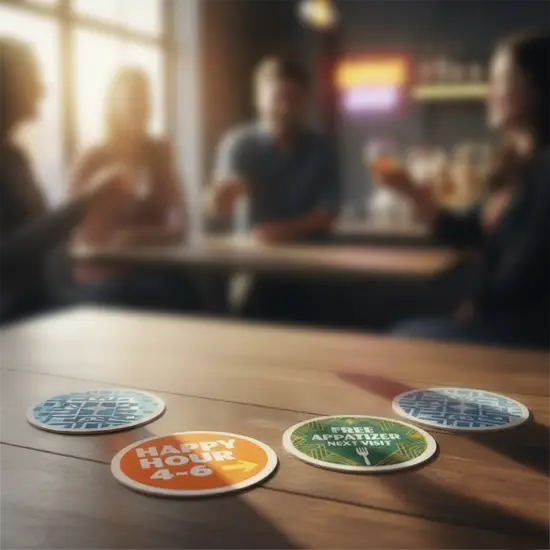
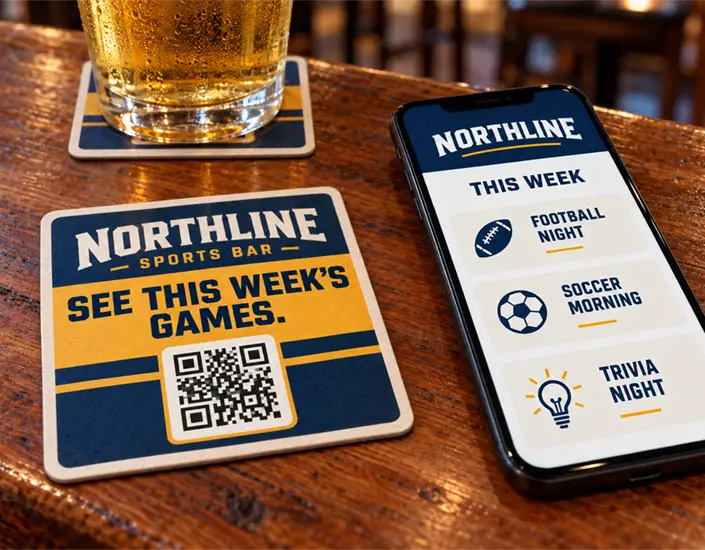
Coaster tie-in: Feature one standing game day special and the day or time it applies. Add a QR code for the current menu or table-booking page.
Halftime Trivia and Prediction Games
Use game breaks for short trivia rounds, and invite guests to submit final-score or first-scorer predictions before kickoff.
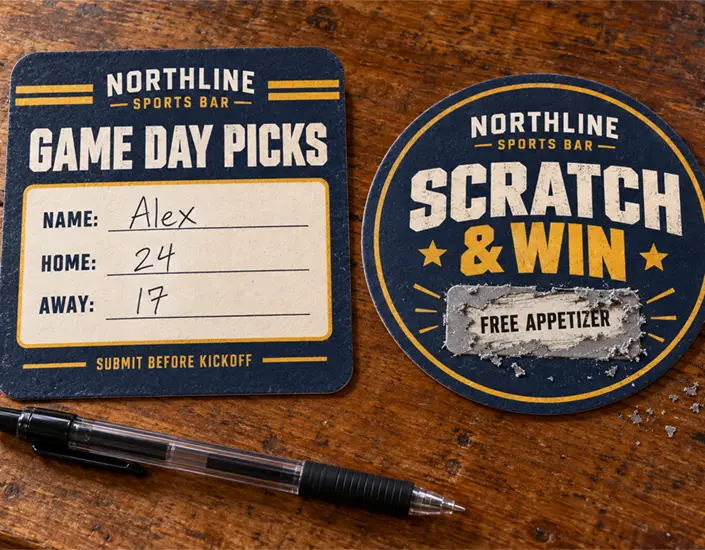
Coaster tie-in: Print a prediction panel with space for picks and a guest name or table number. Collect entries before kickoff and announce winners once the relevant results are confirmed.
Scratch-Off and Numbered Coaster Games
Scratch N' Win coasters add a reveal element at the table, with prizes such as a free appetizer or a reserved table for the next game. If you want each coaster to carry a unique number for a drawing, ask about variable-printing coasters. Prize promotion rules vary by location, so check local requirements before you launch a contest. Confirm quantities, pricing, artwork requirements, and production timing for Scratch N' Win and variable-printing orders before scheduling your promotion.
Fantasy League Nights
In-house fantasy leagues can give members a recurring reason to visit throughout the season.A reserved section, a leaderboard on one screen, and occasional prizes keep participants engaged.
Coaster tie-in: Print the league name and meeting night, with a QR code for registration or next-season interest. Use the design in the reserved league area so other guests can see how to join.
Season Openers and Rivalry Games
The first game of a season and local rivalry games are natural moments for a special design. A dated coaster marks the occasion and gives guests something they may choose to keep.
QR Codes That Encourage the Next Visit
Link season-long coasters to a viewing calendar or booking page that you can update as events change. Give guests a clear prompt, such as "See This Week's Games", "Reserve Your Table", or "Join League Night". Test the QR code at its final printed size and check that the destination works on a phone.
Track Which Game Day Promotions Work
Record attendance, table reservations, offer redemptions, and average spend for each promotion. Track QR activity separately from confirmed bookings or visits. Compare similar game nights to decide which promotions to repeat, adjust, or replace.
Table Presence: Comparing In-Venue Branding Options
Coasters work alongside table tents, menus, signage, and digital screens. The comparison below shows where each format works best.
| Option | Where it lives | What it does well | Limitations |
|---|---|---|---|
| Wall signage | Walls, entry, bar back | Large-format branding and event reminders | Printed details require replacement when promotions change |
| Digital screens | Dedicated displays or bar monitors | Updates specials and schedules | Needs screen space alongside broadcasts |
| Table tents | Tabletops | Displays offers at table level | Can get moved aside during busy service |
| Printed menus | Tables and bar | Presents offers while guests order | Printed updates require replacement |
| Custom coasters | Under drinks and on tabletops | Combines tabletop messaging with a practical function | Small print area limits how much fits |
Pulpboard coasters absorb condensation and keep your specials or upcoming events within reach during the game. Use bar coasters alongside your menus, signage, and other promotional materials.
How Guests Use Coasters During a Game
Knowing how coasters get handled on game day helps you decide what belongs on them.
Before kickoff, guests settle in, order, and look around the room. The coaster is one of the few printed items within arm's reach, which makes it a good place for specials and the upcoming schedule.
During the game, attention is on the screens. The coaster stays under the glass, and guests glance at it between plays and during breaks. Clear, large text and a recognizable design matter more than detail. This is also when a prediction panel or scratch-off gives guests something to do at the table.
Include a recurring viewing night or a QR link to the current calendar so the message remains useful if guests take a coaster home.
Restaurants and bar-and-grill concepts can use the same approach with restaurant coasters, carrying game day messaging into the dining room.
How to Design Game Day Coasters That Print Cleanly
Sports bars are busy and often dim, and coasters are read at arm's length between plays. Design for a quick glance.
Content Checklist
- Choose one primary message: a standing special, viewing schedule, league night, or prediction game
- Leave a clear writing area if guests will enter predictions or trivia answers
- Put days and times where guests can find them first
- Keep body text large and high-contrast
- Leave clear space around QR codes and scratch-off areas
- Add a reason to return, such as "Soccer mornings every Saturday"
Trademark and Licensing Checklist
- Avoid printing league names, team names, team logos, or trademarked event names without permission from the rights holder
- Use generic language such as "Big Game Sunday," "Championship Viewing Party," or "Football Night"
- Get written approval before using a local school's or club's name or logo
- Ask a legal advisor or the rights holder when you are unsure
File Preparation Checklist
- Use File Specifications for Value Pack and High Volume orders. Follow the separate artwork instructions on the Short Run Coasters page for Short Run orders.
- Prepare Value Pack and High Volume artwork in CMYK; follow the submission requirements for Short Run artwork
- Follow the selected product's requirements for bleed, safe area, and resolution
- Check every date, time, special, and URL before submitting
- Review the proof for wording, layout, placement, orientation, and both sides where applicable
Ordering Guidance: Matching Coaster Orders to the Sports Calendar
Plan custom pulpboard coasters around the date you need them on tables. Allow time for artwork, proof approval, production, and shipping.
Printing and Proof Approval
Color: Standard full-color printing uses CMYK. If a brand color must match existing materials, discuss available color-matching options before approving the artwork.
Proofing: Coaster Designer shows an on-screen digital proof. For other orders, a PDF proof is sent for approval before production. Check wording, layout, placement, and orientation. A digital proof is not a physical printed sample and does not guarantee final printed color or show board texture.
Material: Coasters are made from absorbent pulpboard for everyday drink service.
Short Run or Value Pack
Short Run and Value Pack are separate product lines with different quantity ranges and production times.
| Feature | Short Run | Value Pack |
|---|---|---|
| Quantity range | 25 to 500 coasters | 1,200 to 25,000 coasters |
| Typical production time | 3 to 5 business days after proof approval | 10 to 15 business days after proof approval |
| Shipping | Transit time is additional and varies by destination | Transit time is additional and varies by destination |
| Best suited for | Single games, draft nights, and individual events | Full seasons, league nights, and programs across several locations |
If your estimate falls between the listed ranges, or you need several designs in one order, contact the team before finalizing artwork.
Estimating Quantities
For these planning examples, assume two coasters per guest per visit.
- Championship viewing party: 150 guests multiplied by 2 coasters per guest equals 300 individual coasters, which falls within the Short Run range.
- League night: 40 guests multiplied by 2 coasters, across a 16-week season, equals 1,280 individual coasters, which falls within the Value Pack range.
- Football season design: 120 guests multiplied by 2 coasters, across 18 game weekends, equals 4,320 individual coasters, which falls within the Value Pack range.
Confirm available order increments before using these planning estimates to choose an order quantity. For several locations, ask about bulk coasters and packaging for distribution.
Planning Orders Around the Season
Work backward from a delivery date a few days before the first promoted event.
- Set the on-table date. Aim for coasters to arrive a few days before the season or event begins.
- Subtract shipping time. Shipping is separate from production and varies by destination.
- Subtract production time. Use the typical production range shown in the table, counted from proof approval, and confirm the schedule for your required delivery date.
- Subtract proof review time. Leave room for at least one round of revisions.
- Subtract design time. Include time for partners, such as a local school or league organizer, to review their details.
For a season-long Value Pack program, we recommend starting artwork six to eight weeks before the first promoted event to allow time for design, proof revisions, production, and shipping. Confirm any rush service before planning around it.
Frequently Asked Questions
What should a sports bar print on game day coasters?
Choose one primary message: a standing special, viewing schedule, league night, or prediction game. Include the relevant day or time and a clear next step, such as checking the calendar, reserving a table, or registering. Keep text large and high-contrast.
Can a sports bar use team logos or league names on coasters?
Only with permission from the rights holder. League names, team names, team logos, and some event names are trademarks. Generic phrases such as "Big Game Sunday" or "Championship Viewing Party" are common alternatives. For a local school or club, get written approval before using its name or logo, and ask a legal advisor when you are unsure.
How many coasters does a sports bar need for game day promotions?
Multiply expected guests per event by the number of events and estimated coasters used per guest. Base coaster use on your venue's service routine, then confirm the product line and available order increments.
How far ahead should a sports bar order seasonal coasters?
Allow time for artwork, proof approval, production, and shipping. We recommend starting season-long Value Pack artwork six to eight weeks before the first event. For both Short Run and Value Pack, confirm the production and shipping schedule for your required arrival date.
Next Steps for Your Game Day Calendar
Map your next 90 days of games, choose promotions you can run consistently, and plan a coaster with a clear reason to return, such as the next viewing night, league registration, or a reservation offer.
Explore custom coasters and promotional coasters to choose an approach for your venue. Submit your artwork, event date, and estimated quantity when you request a quote for a single event or a full-season program.
Share: