Round vs. Square Coasters: Which Shape Works Best for Your Brand
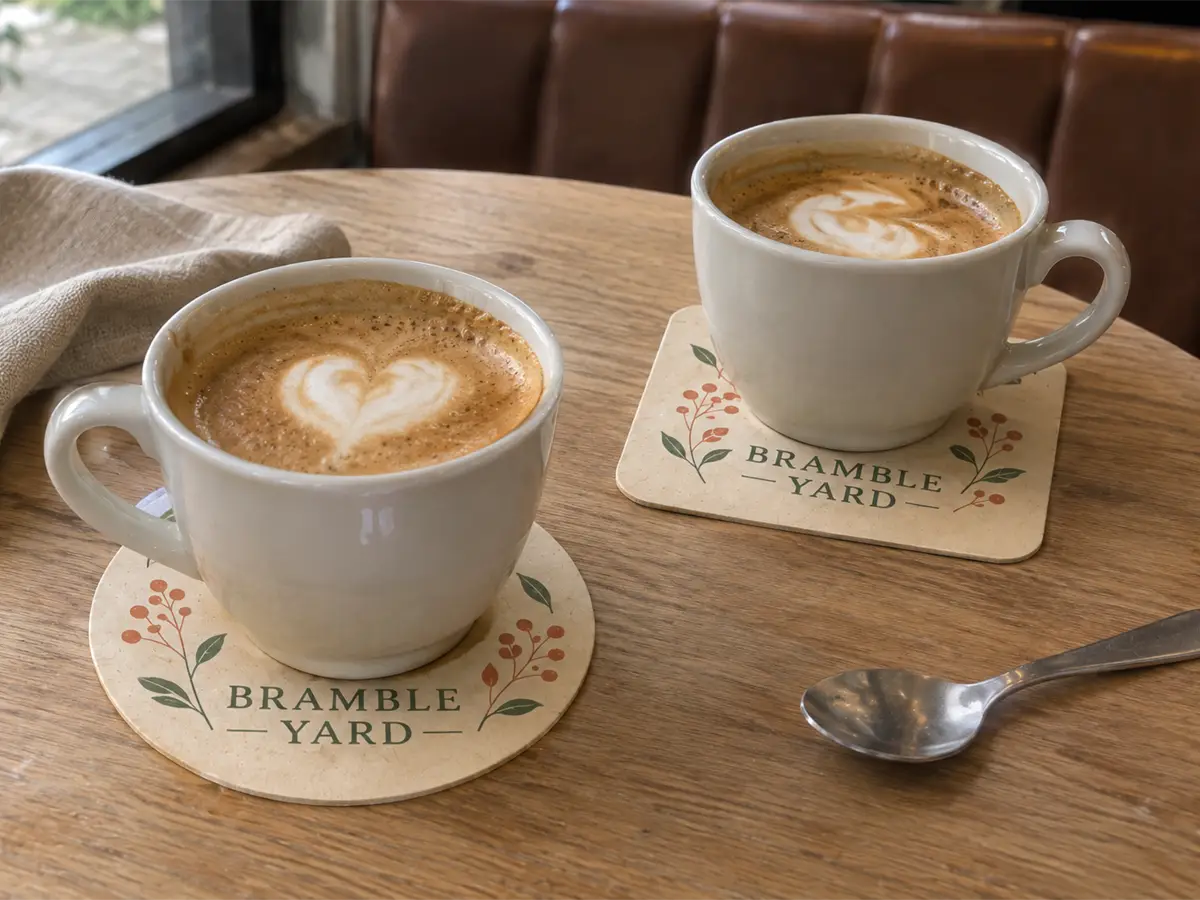
 A well-designed coaster makes every inch count. - Coaster Factory
A coaster sits on a table for the duration of a drink. Sometimes longer. That single placement creates dozens of impressions, whether the person holding the glass notices consciously or not. But before any of that happens, you need to decide: round or square?
Most buyers choose based on personal preference. They like how one shape looks more than the other. That instinct is fine, but it overlooks the practical factors that affect how your brand appears on a table. Print area, edge visibility, design layout, and table presence all vary between round and square coasters, and those differences matter more than aesthetics alone.
Here is what you will learn in this article:
- How print area and usable space differ between round and square formats
- What each shape does for logo placement, edge printing, and table visibility
- How production factors compare, and when custom shapes make sense
Summary:
- Square coasters offer more face area at the same nominal size, giving text and multi-element layouts more room
- Round coasters create a classic, symmetrical look and suit centered logos or circular brand marks
- Round and square are standard formats, with pricing and turnaround determined by the selected product and order specifications; custom shapes are also available
The Practical Differences Between Round and Square Coasters
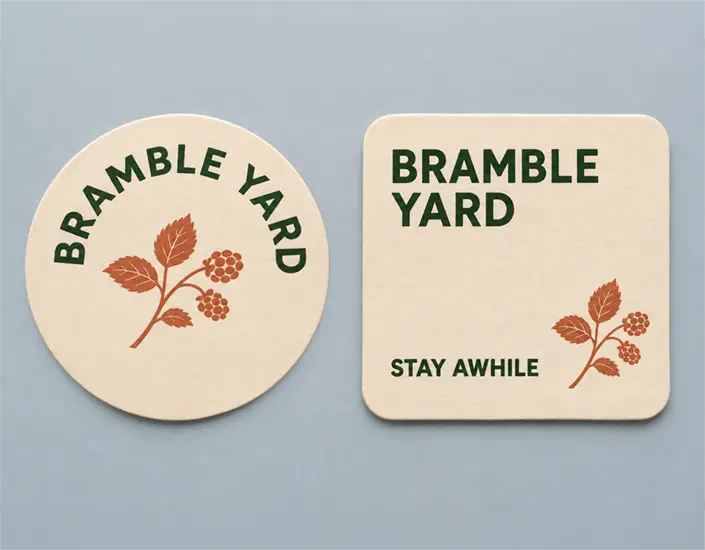
When you compare round and square coasters at the same nominal size, the square version offers more surface area because of the geometric difference between circles and squares. A 4-inch square coaster has approximately 16 square inches of face area before allowing for rounded corners. A 4-inch round coaster has roughly 12.6 square inches. The square therefore provides approximately 27% more face area than the round coaster. Important content still needs to fit inside the safe area for either shape.
For brands with simple, centered logos, that difference rarely matters. But for designs that include taglines, QR codes, event dates, or multiple elements, the extra space on a square format provides meaningful breathing room.
Edge behavior also differs. Square coasters have flat edges that align with rectangular elements in your design. If your logo sits in a box, or your artwork includes border lines, a square coaster accommodates those elements without awkward cropping. Round coasters have a curved perimeter. Rectangular artwork needs to be arranged within the circular outline to avoid unintended cropping.
Neither is better in absolute terms. The question is which behavior matches your design.
Table presence is another consideration. Round coasters can support a traditional bar or beverage style, while square coasters can suit modern or corporate layouts. Both work in hospitality environments, and the overall impression also depends on typography, color, and imagery.
When you order custom coasters, you are not locked into one shape. Understanding the trade-offs helps you match the format to your design instead of forcing your design to fit a format.
Print Area and Design Layout: What Each Shape Supports
Square Coaster Design Advantages
Square coasters excel when your design includes:
- Text-heavy layouts such as event details, menus, or promotional messaging
- Corner-anchored elements like QR codes or social handles
- Horizontal or vertical lockups where the logo has a rectangular footprint
- Multiple design elements that need separation and hierarchy
The flat edges and corners give designers more flexibility to create zones within the layout. A logo in the center, a tagline below, and a QR code in the corner all have distinct areas to occupy.
Square formats accommodate full-bleed background colors, photographs, and patterns. Round coasters can also be printed edge to edge when the artwork includes the required bleed for the selected product.
Round Coaster Design Advantages
Round coasters work well when your design includes:
- Centered circular logos such as brewery emblems, seals, or monograms
- Circular or radial graphic arrangements that follow the coaster's outline
- Minimalist branding with a single focal element
- Classic bar or beverage aesthetics where the round shape reinforces tradition
The shape itself becomes part of the design. A circular logo centered on a round coaster creates natural harmony. The eye moves easily around the surface without hitting corners.
Scratch-and-sniff or scented coasters are available in round, square, and custom shapes. Choose the format that best accommodates your artwork and intended use.
A Quick Comparison
| Factor | Square Coasters | Round Coasters |
|---|---|---|
| Approximate face area at a nominal 4-inch size | 16 sq. inches before allowing for rounded corners | 12.6 sq. inches |
| Best for | Text, corner-positioned elements, multiple elements | Centered logos, circular marks |
| Edge behavior | Straight sides with rounded corners | Circular perimeter |
| Table presence | Can suit modern or corporate layouts | Can suit classic bar or beverage layouts |
| Full-bleed printing | Available with correctly prepared artwork | Available with correctly prepared artwork |
Both shapes are available with standard full-color CMYK printing. Production requirements depend on the selected product, size, and any specialty features.
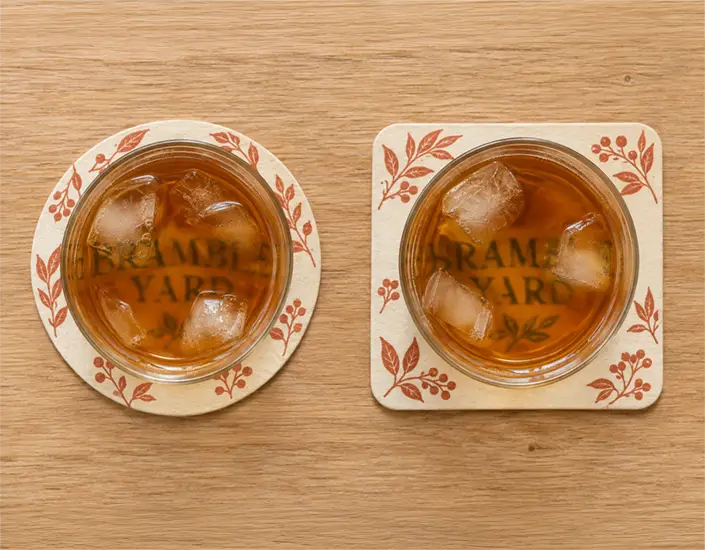
Edge Printing and Shape Visibility
The perimeter of your coaster does more work than most buyers realize. A glass can obscure part of the printed design. How much artwork remains visible depends on the glass base, its position, and the coaster's size and shape.
Square coasters can leave more artwork visible around a glass, particularly at the corners. The amount of exposed artwork depends on the glass base and its placement. readable while the drink is on the table.Important information positioned toward the corners may remain visible, but all text, logos, and QR codes must stay inside the required safe area. For Value Pack and High Volume orders, keep important content at least 3/16 inch inside the cut edge; follow the separate artwork instructions for Short Run orders.
A centered glass with a base smaller than the coaster can leave an even border of artwork visible on a round coaster. A square coaster of the same nominal size can leave additional artwork exposed at the corners.
This matters for designs where you want edge visibility, such as:
- Promotional messaging around the perimeter
- Repeated patterns that should remain visible during use
- Secondary brand elements (social handles, URLs) positioned near corners
If your design lives primarily in the center, the shape choice affects visibility less. A glass can obscure a centered logo in either format. But if you want your coaster to communicate while in active use, square formats generally expose more.
For guidance on preparing your artwork for either shape, review the file specs and artwork guidelines before submitting.
Production Practicality: Die Costs, Timing, and Equipment
Buyers sometimes assume that square coasters are harder to produce, or that round coasters require special dies. In practice, round and square are standard formats in our coaster range.
Standard round and square formats are available without developing a new custom outline. Production timing depends on whether you choose Short Run, Value Pack, High Volume, or a specialty option. Your quote or order details will confirm pricing and the production schedule for your selected specifications.
The production variables that actually affect timing include:
- Custom sizes outside standard ranges (which may require new dies)
- Proof approval delays (turnaround begins after you approve the proof)
- Order volume and any special packaging or collating requirements
- Special finishes or features (scented, scratch-and-win, thermochromic)
For standard formats, consider the product line and complete order specifications when planning production.
Production Notes
Standard full-color coasters use CMYK printing. For Value Pack and High Volume orders, prepare artwork in CMYK and provide target Pantone references if color matching is important. Follow the separate artwork instructions for Short Run orders. Screen colors may differ from the finished print. Approve the on-screen artwork when ordering through Coaster Designer; for orders handled directly by our team, approve the PDF proof before production. Production time begins after artwork approval, and shipping time is additional. For edge-to-edge printing, follow the bleed and safe-area requirements for your selected product in our file specs and artwork guidelines.
When Neither Shape Fits: Custom and Stock Library Options
Some brands need a shape that is neither standard round nor standard square. A hexagon for a brewery. A coaster shaped like a state outline. A cloud-shaped coaster for a themed promotion.
Two paths exist for non-standard shapes:
- Stock library shape coasters let you choose from existing die-cut shapes. These use an existing cutting die rather than requiring a completely new custom outline. Options include octagons, hexagons, ovals, and other specialty shapes. Confirm pricing and production timing for your chosen shape and order specifications.
- Custom shapes within 4x4 let you create a fully custom die shape within a 4-inch by 4-inch boundary. If your brand mark has a distinctive outline or your event theme calls for something unique, this is the option for you. Larger custom-shape options are also available; request a quote for the dimensions you need.
Custom dies add a step to production, but the process is straightforward. We review the shape for print feasibility, produce a proof, and proceed once you approve.
Custom Shape Checklist
Before requesting a custom shape, confirm:
- Your design fits the dimensions of your selected custom-shape option
- The shape includes no extremely thin points that could tear during handling
- Your proposed cut line is clearly identified and prepared according to our team's artwork instructions
- You have reviewed our file specs for bleed and resolution requirements
- The shape leaves enough usable surface for the intended glassware
Addressing Common Questions
What is the typical diameter of a round coaster?
Standard round coasters are commonly 3.5 inches or 4 inches in diameter. The 4-inch size provides more face area than a 3.5-inch round coaster, giving your artwork additional room. We produce both sizes, with 4-inch being the most popular for branded applications.
Where can I find silicone coasters?
Coaster Factory manufactures pulpboard coasters only. Silicone coasters are a different product category. If you need a disposable, printable coaster for bar, restaurant, or promotional use, pulpboard coasters are the industry standard.
Are wooden coasters safer than steel?
There is no universal safety ranking between wooden and steel coasters; suitability depends on the specific product, its condition, and how it is used. Pulpboard coasters are suitable for short-term hospitality use and can be reused while they remain in good condition. They absorb moisture, help protect surfaces, and display branding, and can be air-dried between uses. We do not manufacture wooden or steel coasters.
Are cork or ceramic coasters better?
Cork and ceramic are reusable coaster materials, but the better choice depends on the intended use, design, and budget. For high-volume, branded applications where coasters are distributed, replaced, or used for promotional purposes, pulpboard is a practical choice. It supports full-color printing and bulk ordering; compare quotes based on your required quantity and specifications.
Conclusion: Choosing the Right Shape for Your Brand
Shape selection comes down to design fit, not personal preference. Here are the key takeaways:
- At a nominal 4-inch size, square coasters provide approximately 27% more face area than round coasters before allowing for rounded corners, giving text and multi-element layouts more room
- Round coasters create a classic, symmetrical look and work well for centered logos and circular brand marks
- Round and square are standard formats; pricing and production timing depend on the selected product and order specifications
- Custom shapes are available through the stock library or a custom die-cut option, including formats within 4x4 and larger sizes
- Square formats can leave more artwork visible around a glass, depending on the glass base and its placement
Next Steps
Start by reviewing your existing logo and brand assets. Identify whether your design is centered and circular, or whether it includes text, corners, or multiple elements that benefit from more space.
If you have artwork ready, upload it using our coaster designer tool to preview how it looks in both formats. If you need guidance on quantities, turnaround, or print constraints, request a quote, and we will walk through the options.
The right shape makes your brand readable, recognizable, and present on the table. We can help you figure out which one that is.
Share: